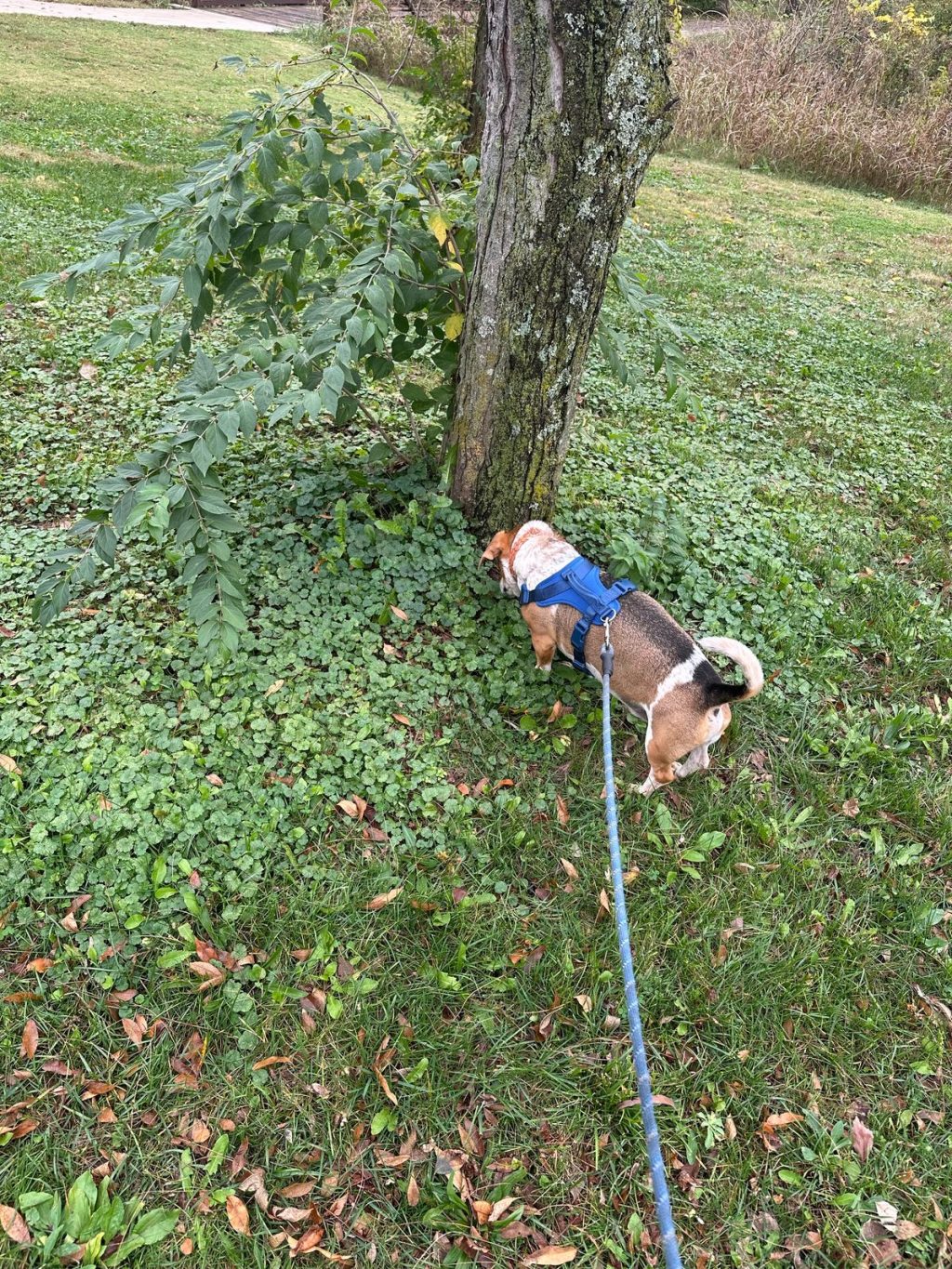
Hi, it’s Banner. I have a beagle’s nose and a dachshund’s legs, so I was built for one kind of adventure: the slow, thorough kind. The walk I like best has a name. It’s called a sniffari, and if your dog has a gray muzzle, short legs, or a nose that runs the show, I think you’ll like it too.
What Is a Sniffari?
A sniffari (you’ll also hear “sniff walk,” “scent walk,” or “decompression walk”) is a walk where the dog’s nose sets the agenda. You’re not trying to cover distance or reach a destination. The dog picks the direction and the pace, and stops as long as they like to investigate whatever is interesting.
The American Kennel Club describes sniff walks as focused on “scent exploration rather than exercise, distance, or reaching a destination” [1]. On a regular hike, I stop for a good sniff about every 10 minutes. On a sniffari, the sniff is the hike.
Why Sniffing Counts as Exercise
When my human slows down and lets me read the news, he’s not just being nice. Sniffing is real work for a dog’s brain.
The nose is a big deal
Dogs have more than 200 million scent receptors, compared with about 6 million in people, according to the AKC [1]. Sorting through all that information takes concentration and raises a dog’s breathing rate. One trainer told the AKC that dogs can get enough sniffing done in 20 to 30 minutes to be “just as tired as an hour walk without sniffing” [1]. That’s expert opinion, not a study, but it matches what a lot of nappy dogs would tell you.
Sniffing and optimism: what the research says
The best-known study here is from 2019. Researchers Charlotte Duranton and Alexandra Horowitz gave pet dogs a “cognitive bias test,” which checks how quickly a dog approaches an ambiguous bowl that might or might not have food in it. A faster approach is read as a more optimistic outlook [2].
Then one group of dogs practiced nosework (scent games) for two weeks, while another practiced heelwork (walking closely at the handler’s side). After two weeks, the nosework dogs approached the ambiguous bowl faster. The heelwork dogs didn’t change [2]. The authors concluded that giving dogs more time to use their noses made them more optimistic, and that more “foraging” time improves welfare [2].
It was a small study of nosework games, not walks. Still, it’s a good sign that letting a dog sniff and make choices is good for how they feel.
Why Sniffaris Suit Senior and Short-Legged Dogs
- The pace is gentle. It’s mostly standing, sniffing, and ambling. No keeping up with long human legs.
- Distance isn’t the goal. You may cover very little ground, and that’s fine [1]. About 2 miles is my realistic hike, and above 85°F even 1 mile is pushing it. A sniffari gives me a full adventure without overdoing my legs.
- It’s easy to turn back. Stay close to the car or home. I once took sit breaks about every 100 feet on the way back to the car, and that’s when we started keeping hikes shorter.
- Old brains like a challenge. A two-year study of aging beagles found that enrichment (exercise, socialization, and new toys) helped preserve their learning ability [3]. It wasn’t about sniffing specifically, but a sniffari is a daily dose of new information.
My vet hasn’t put any limits on my walks, but every dog is different. If your dog has arthritis, heart or breathing problems, or a back condition, ask your vet what’s comfortable before you head out.
How to Do a Sniffari
You don’t need much. The AKC suggests a well-fitting harness and a long line of 10 to 15 feet, so the dog can explore without pressure on the neck [1].
Long line or loose leash
- Long line (10 to 15 feet): Best in open, quiet spots. Be ready to reel it in [1].
- Regular 6-foot leash, kept loose: Fine for sidewalks and busy trails.
- Skip the retractable leash. Preventive Vet doesn’t recommend them [4].
My human uses my regular 6-foot leash the vast majority of the time, because I tend to get too tangled up on a long leash. So the long line above is a tip for other dogs, not what I use.
Pick a route
Choose somewhere safe and quiet. The AKC says the best spots have grass, trees, bushes, and natural terrain [1]. For older dogs, flat and close to the car is perfect.
Let the dog lead
When it’s safe, let your dog pick the direction, stop when they stop, and keep verbal cues to a minimum [5]. You’re the safety officer, not the tour guide.
How long?
There’s no magic number. Quality matters more than length, and 20 to 30 minutes of sniffing can be plenty [1]. For a senior, start shorter and watch how your dog does that evening. After a good outing, I crash in whichever bed is closest to my human.
How to Run Your First Sniffari (Step by Step)
- Pick a time when you’re not in a hurry [5].
- Check the weather. Older dogs are more prone to heatstroke [6], so go early or late on warm days.
- Gear up: harness, long line or 6-foot leash, water, bags, and treats.
- Start somewhere quiet, like a park corner or a flat stretch of trail.
- Let your dog choose. When they stop to sniff, you stop [5].
- Stay quiet. Save commands for safety.
- Turn back early, before your dog seems tired.
- Do a body check of paws, ears, and fur for ticks and debris [4][7].
- Watch the evening and next morning. Sleepy is good. Stiff or limping means go shorter next time.
Sniffari Ideas: City vs. Trail
City and neighborhood sniffaris
The AKC notes that sniff walks are especially valuable for city dogs without yards [1].
- The grassy strip along a quiet side street
- Park edges, tree lines, and fences
- The same block, explored in a new direction
Watch for dropped food, bones, broken glass, and hot pavement.
Trail and park sniffaris
- A short, flat out-and-back, so turning around is easy
- A wide, mowed trail edge where you can see what’s ahead
Stick to the center of the path to reduce tick exposure [7].
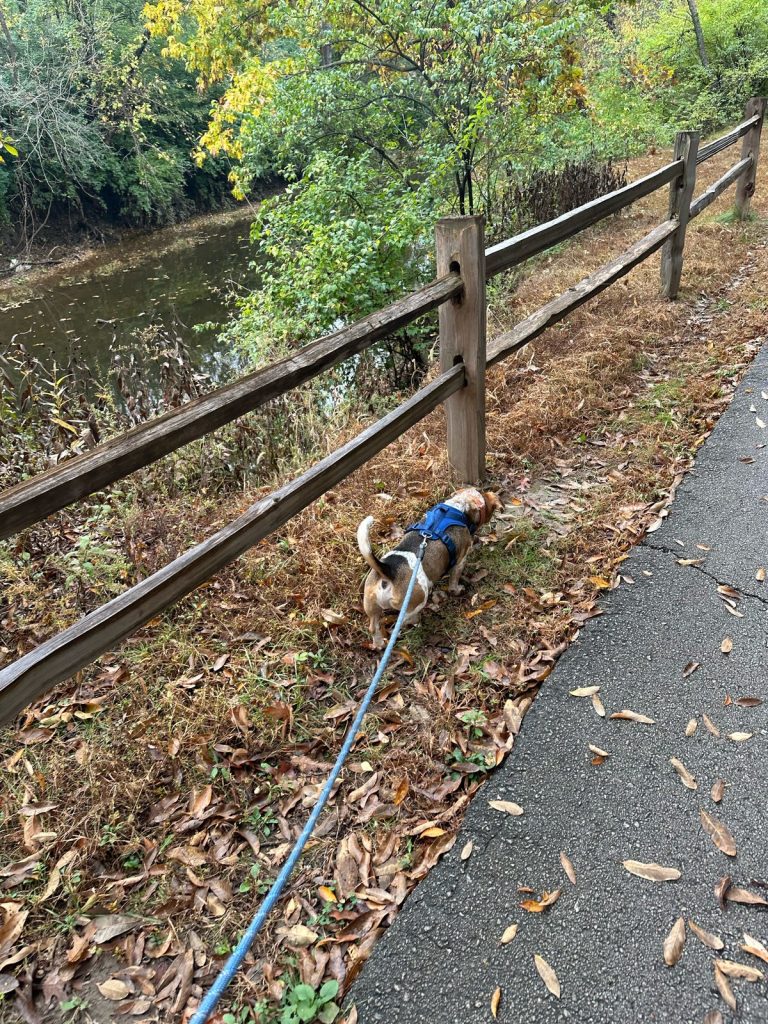
My favorite sniffari spot is anywhere with trees. I really love sniffing around them. My human thinks I’m trying to figure out how many squirrels have gone up and down each tree that day. Beyond trees, I’m a scent hound, so you never really know what will grab my attention. My human says it’s always fun to see what gets me to stop, other than trees.
Etiquette and Safety
Be a good neighbor
- Give people and dogs space. Reel in when someone approaches [4][5].
- Follow leash rules. Many parks cap leash length, so check before you go.
- Stay off private gardens, and always pick up after your dog.
Ticks
The CDC recommends checking dogs for ticks daily, especially after time outdoors. Look in and around the ears, around the eyelids, under the collar, under the front legs, between the back legs, between the toes, and around the tail [7]. Ask your vet about a tick preventive.
Wildlife
Keep your dog away from wildlife, including snakes [4]. A long line gives you control only if you’re paying attention.
What not to let them sniff into (or eat)
- Standing water and puddles. The AVMA says slow-moving or stagnant water can carry leptospirosis [8].
- Scummy or discolored ponds. Blue-green algae can make dogs very sick, very fast [9].
- Wild mushrooms. Some are toxic. If your dog eats one, call your vet or ASPCA Animal Poison Control at (888) 426-4435 right away [10].
- Dead animals, rodents, and wildlife poop. Sniffing is the point. Eating is not [8].
- Trash, food scraps, and bones on city routes.
Read your dog
Relaxed sniffing comes with a soft expression and a loose body. A stressed dog may look tense or unable to settle [1]. If your dog seems worried, go somewhere quieter.
Pack Light, Sniff Long
Water, bags, treats, and a tick remover cover most sniffaris. For a checklist that keeps the basics in one place, grab our free Dog Road Trip Packing List. It’s built for longer trips, but the everyday basics work for a sniffari too.
📋 Free Printable: The Dog Road Trip Packing List
Everything my human and I pack for a road trip, on two printable pages. That includes the senior and short-leg extras and our rest-stop routine. Join Trail Mail and it’s yours, free.
FAQ
What is a sniffari?
A walk where your dog’s nose sets the pace and the direction. The focus is on scent exploration, not distance or speed [1].
How long should a sniff walk be?
Quality matters more than length. The AKC’s experts say 20 to 30 minutes of sniffing can tire many dogs out [1]. For a senior, start shorter and see how they feel later.
Is a sniffari enough exercise?
Sometimes, but not always. The AKC says sniff walks add enrichment and some activity, but many dogs still need other exercise based on age, breed, and health [1]. Ask your vet what’s right for yours.
What leash is best for a sniffari?
A harness with a 10- to 15-foot long line in open areas, or a regular leash kept loose in busy ones [1]. Avoid retractable leashes [4].
The Bottom Line
A sniffari is the easiest adventure there is. Slow down, loosen the leash, and let your dog read the world. You may only go a few blocks, but your dog’s brain goes a long way. Then, if I have anything to say about it, there’s a blanket to burrow under.
Related reads: Hiking With a Senior Dog: What I’ve Learned on the Trail at 12 · Gentle Stretches and Warm-Ups for Senior Dogs · Meet Banner · Free Dog Road Trip Packing List
Banner’s human is not a veterinarian or a dog trainer. This post shares personal experience and general information from the sources below. It’s not veterinary advice. Please talk to your vet about what’s right for your dog.
Sources
- American Kennel Club, Why Sniff Walks Are So Good for Your Dog (updated Sept. 23, 2026) — https://www.akc.org/expert-advice/health/is-sniffing-a-dog-s-version-of-social-media/
- Duranton, C., & Horowitz, A. (2019). Let me sniff! Nosework induces positive judgment bias in pet dogs. Applied Animal Behaviour Science, 211, 61–66 — https://doi.org/10.1016/j.applanim.2018.12.009
- Milgram, N. W., et al. (2005). Learning ability in aged beagle dogs is preserved by behavioral enrichment and dietary fortification: a two-year longitudinal study. Neurobiology of Aging, 26(1), 77–90 — https://pubmed.ncbi.nlm.nih.gov/15585348/
- Preventive Vet, Dog Boredom Buster: The Sniffari Walk — https://www.preventivevet.com/dogs/boredom-busters-for-your-dog-sniffari-walk
- American Kennel Club, How to Incorporate Dog Training Games Into Your Walks — https://www.akc.org/expert-advice/training/dog-training-games-for-walks/
- AVMA, Warm Weather Pet Safety — https://www.avma.org/resources-tools/pet-owners/petcare/warm-weather-pet-safety
- CDC, Preventing Ticks on Pets — https://www.cdc.gov/ticks/prevention/preventing-ticks-on-pets.html ; and How to Check Your Pet for Ticks (PDF) — https://www.cdc.gov/healthy-pets/media/pdfs/publications/check-pets-for-ticks-508.pdf ; and Ehrlichiosis in Dogs fact sheet (walk in the center of trails) — https://www.cdc.gov/ehrlichiosis/pdfs/fs-ehrlichiosisowners-508.pdf
- AVMA, Leptospirosis in Dogs — https://www.avma.org/resources-tools/pet-owners/petcare/leptospirosis
- CDC, Preventing Pet and Livestock Illnesses Caused by Harmful Algal Blooms — https://www.cdc.gov/harmful-algal-blooms/prevention/preventing-pet-and-livestock-illnesses.html
- ASPCA, The Fungus Among Us: Mushroom Toxicosis — https://www.aspca.org/news/fungus-among-us-mushroom-toxicosis


Leave a Reply