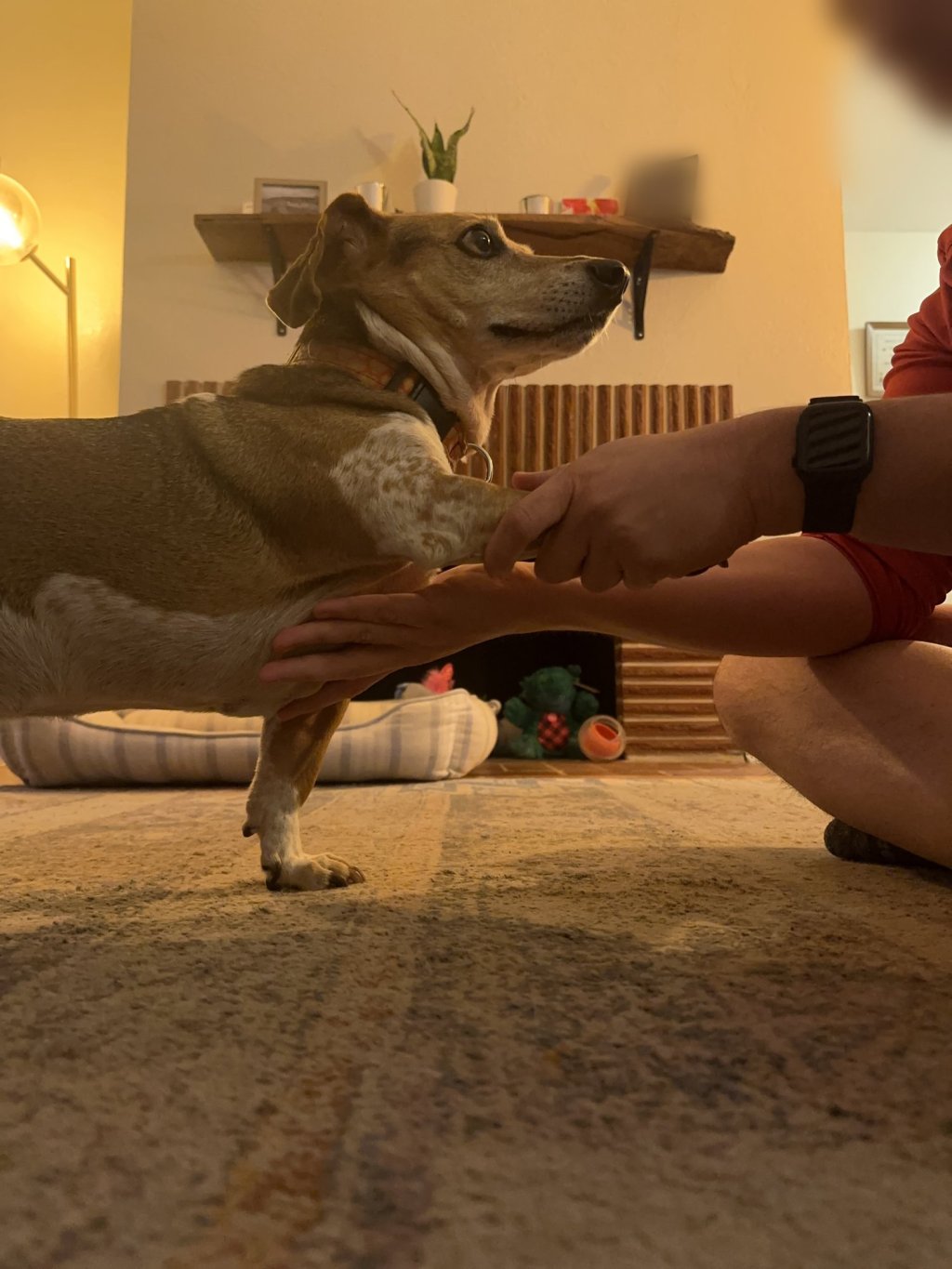
Hi, it’s Banner. I’m 12, and like plenty of gray-muzzled dogs, I don’t hop out of bed ready to sprint. Neither does my human, if we’re being honest.
Human athletes warm up before a workout and cool down after. Older dogs may need it most. My human isn’t a vet or a rehab therapist, and he didn’t know the official names for the leg stretches he does with me, so he went looking. Here’s what we found, in plain language.
Why Warm Up an Old Dog?
A warm-up gradually raises body and muscle temperature and blood flow, which helps muscles and joints move through their full range [1][2]. AKC Pet Insurance notes that warm-ups are thought to lower the risk of injury, which makes them “an especially smart addition” for senior dogs [2].
Cool-downs let breathing and heart rate come down gradually, and they’re a good moment to notice soreness or limping early [1][3].
The honest part: a sports-medicine vet notes there isn’t much research on warm-ups in companion dogs, so a lot of the advice borrows from human sports medicine [1]. That’s why we keep everything gentle and short.
Read This First: Safety Rules
- Ask your vet first if your dog has arthritis, IVDD or any back or neck history, a recent injury or surgery, or a heart or breathing condition. The AKC says to get your vet’s approval before any conditioning program [4]. Better yet, have them show you the leg stretches in person.
- Never force a joint. Move slowly and stop where you first feel resistance. A very small movement still counts [12].
- Stop if your dog pulls away. If your dog tugs the leg back, hops, or tries to walk off, let go and end the session [12]. Shaking legs, heavy panting, wide eyes, yawning, a hunched back, a yelp, or a flinch all mean you’re done for the day too [1][5].
- Use non-slip footing. Grass, a rug, or a yoga mat beats a slick floor [5][10].
- Keep it short. You shouldn’t see fatigue during a warm-up. If you do, it’s too much [1].
My vet hasn’t limited my walks or hikes. That’s a different question from stretching, though, so check with your own vet about your dog.
The Pre-Hike Warm-Up
The goal is to wake the body up, not to tire it out. Plan on about 5 to 10 minutes total [1].
1. The slow warm-up walk
Start with about 5 minutes of easy, loose-leash walking [2]. For me, the first few minutes on the trail are a slow stroll anyway. My nose likes the head start [1].
2. Optional, for other dogs: standing weight shifts
I don’t do this one, but other dogs may like it. With your dog standing squarely, use a Milk-Bone held at nose height to get them to lean slightly forward, then slightly back, without letting them sit or step [5]. It’s a simple balance exercise, and a few slow reps are plenty.
3. Sit-to-stand
This one is part of my real warm-up. Ask for a sit, then lure into a stand with a Milk-Bone held at nose level, moving slowly forward [4]. My human aims for about 15 seconds of sit-to-stands, going at my pace, so it’s however many slow ones I feel like doing, not a race. It’s a common warm-up and a standard rehab exercise [2][6]. If your dog pushes up with the front legs first, tell your vet. AAHA lists that as a possible sign of hip problems or arthritis [7].
The Post-Hike Cool-Down: Standing Leg Stretches
This is where the stretching belongs. Muscles are warm, and I’m calmer. AKC Pet Insurance says to skip passive stretching before exercise but includes it in the cool-down, after a few minutes of easy walking [2].
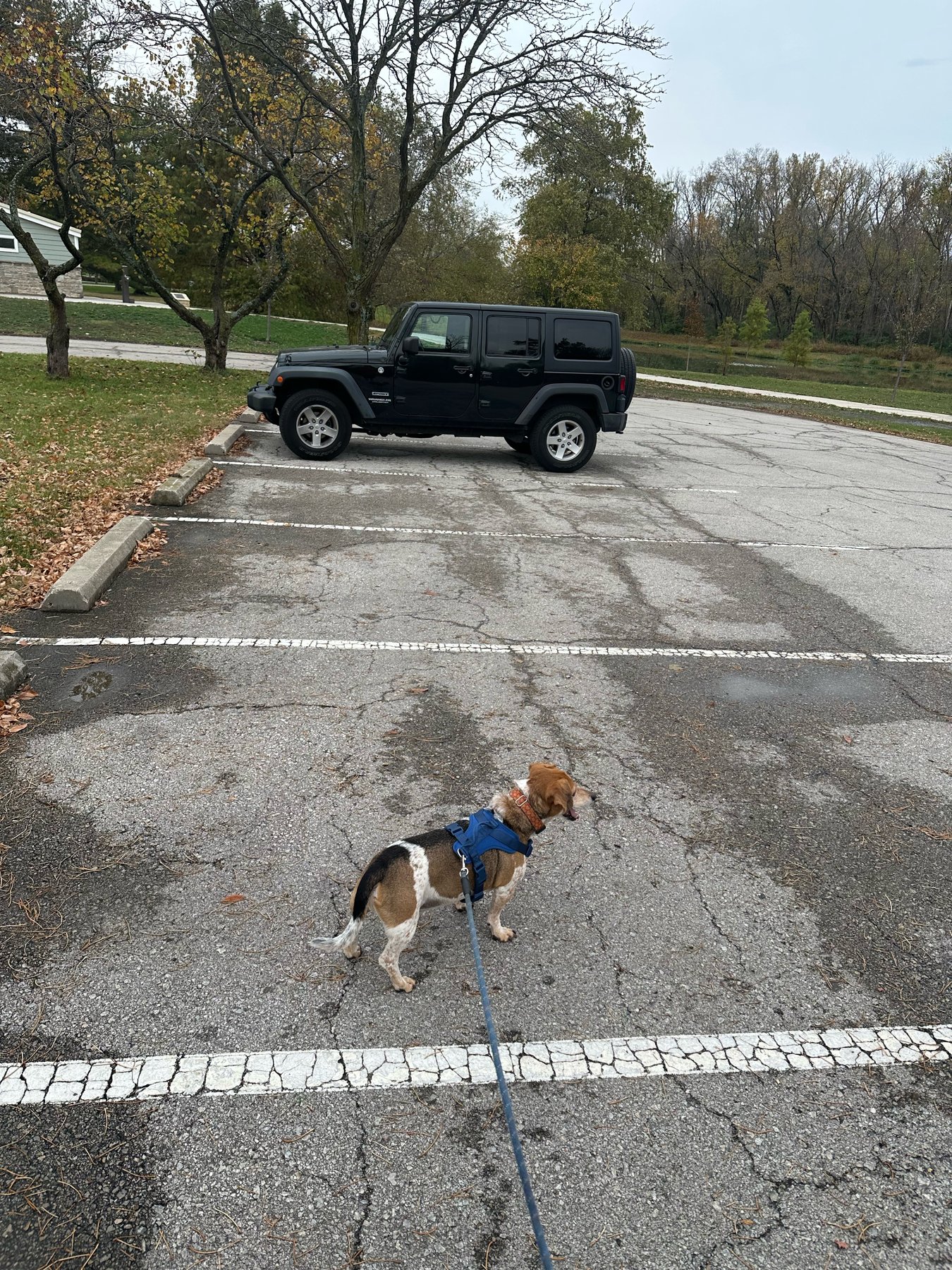
First, the slow cool-down walk
Make the last 5 to 10 minutes an easy walk, and let breathing settle before you stretch [1][2].
What these stretches are called
My human calls them “push-pull” stretches. The rehab name is passive range of motion, or PROM. “Passive” means the person moves the leg and the dog just relaxes. “Range of motion” is how far a joint can comfortably bend and straighten [12][13].
PROM is often done with the dog lying on their side [12]. I won’t cooperate with that, so my human does everything with me standing. One vet practice’s owner handout includes a standing version for exactly that reason [12]. Standing has a catch: I’m balancing on three legs while one is being moved, so keep each lift low, and let the leg down early if your dog wobbles [12].
How my human sets up:
- I stand square on a rug, a mat, or grass.
- He kneels beside me and keeps one arm under my belly or chest, so my back stays level and I can lean on him.
- He holds above and below the joint he’s moving, not just the paw [12].
- He moves the leg straight forward or back, in line with my body, not out to the side [12].
- He eases the leg until he feels me start to resist, then lets it go back. That’s one rep [12][13].
- He does about 5 slow reps of each stretch on one side, then switches sides. He found I’m much more willing to do reps than to hold a stretch for a set time, so we skip the timed holds.
That’s my whole stretching routine: four standing push-pull stretches, one leg at a time. No head or neck moves, and nothing lying on my side.
1. Front leg forward (shoulder extension)
Hand behind the elbow, he slowly eases my front leg forward, a bit like a slow-motion high five, but low [12][14]. That opens up the shoulder. Reps: about 5 per side.
2. Front leg back (shoulder flexion)
He lets my wrist and elbow fold softly, then eases the leg back toward my belly. He keeps it small and slow. If I hop, he’s gone too far [12]. Reps: about 5 per side.
3. Back leg back (hip extension)
With his hand just above my knee, he gently pushes the leg straight back behind me [12][13]. He doesn’t pull from the paw [12]. It stretches the muscles at the front of the hip [13][14]. Reps: about 5 per side.
4. Back leg forward (hip flexion)
He supports under my knee and above my ankle, then eases the whole leg up and forward toward my belly [12][15]. Reps: about 5 per side.
Optional, for other dogs: little bends at the wrist, elbow, and knee
This isn’t part of my routine, but other dogs may like it. With a leg lifted just off the ground, you slowly fold and unfold the wrist and elbow on a front leg, or the knee and ankle on a back leg. Put together, it looks like slow pedaling. Rehab handouts call it a bicycle motion [15]. Just a few soft pedals, and the paw goes back down.
If it were up to me, every leg would end with a Milk-Bone.
Finish with a paw check
Penn Vet’s Working Dog Center ends its cool-down by checking paws, pads, and nails [3]. My human already checks my pads for acorns or small sticks. Add a tick check while you’re down there.
Then I crash in whichever bed is closest to my human.
Notes for Long-Backed and Short-Legged Dogs
The dachshund half of me comes with a long spine. Dachshunds and beagles are both among the breeds at higher risk for intervertebral disc disease (IVDD) [8][9].
- Support the belly and chest. Keep one arm under the body during every leg stretch, so the dog doesn’t sag or twist [12][15]. On short legs, a lift of a few inches is plenty.
- Keep the spine level. No bending, twisting, or arching the back to get more stretch. Move the leg, not the back [15].
- No jumping. The AKC notes that jumping or a hard landing can injure a disc [8]. Cornell recommends ramps or steps [9].
- No fast turns or slippery floors. A rehab vet lists slick surfaces, rough play, and stairs among things for disc patients to avoid during recovery [10].
- If your dog has had a back episode, follow your vet’s plan, not a blog post.
What We Leave Out
These aren’t part of my routine. Some are fine for other dogs, with your vet’s OK.
- Head and neck moves. Some people use cookie stretches, where a Milk-Bone guides the dog’s nose toward a shoulder or hip [2][5]. I won’t cooperate with head or neck moves, so we don’t do them. Other dogs may like them.
- Passive stretching before a hike. Leg stretches go in the cool-down, not the warm-up [2].
- Lying-on-the-side stretches. Some dogs do these same leg stretches lying on their side [12]. I won’t cooperate with that, so we do every stretch standing. Other dogs may like it.
- Balance boards and wobble cushions. These are real rehab exercises, but VCA recommends doing them with a therapist’s guidance [5].
- Anything that hurts. Always.
Get the Dog Stretch & Warm-Up Sheet
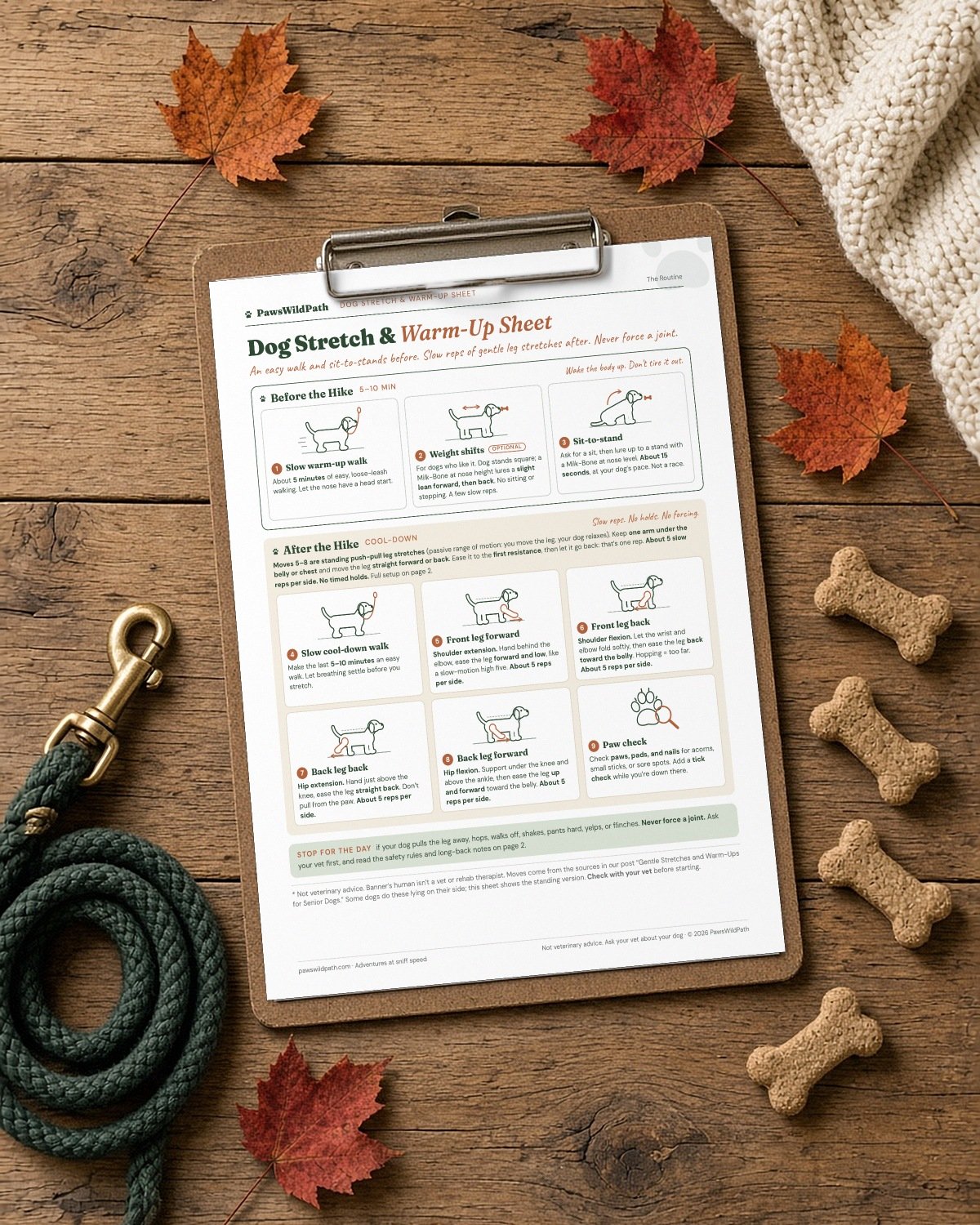
We turned this routine into a printable for the door or the car. It has:
- The warm-up: a slow walk and sit-to-stands (plus optional weight shifts for other dogs)
- The cool-down: slow walk plus the four standing push-pull leg stretches, about 5 reps per side
- Stop signs, an “ask your vet first” checklist, and long-back tips
- A weekly tracker
The Dog Stretch & Warm-Up Sheet is free for email subscribers. Sign up below and we’ll send it straight to your inbox. Rather skip the email list? It’s also available for $5 in our Etsy shop.
FAQ
Should I stretch my senior dog before a walk?
Start with an easy walk instead. I add about 15 seconds of sit-to-stands at my own pace. Save leg stretches for after, when muscles are warm [1][2].
What is passive range of motion for dogs?
It’s when a person slowly bends and straightens a dog’s joints for them while the dog relaxes. Stop at the first resistance [12][13].
Do I need to hold each stretch for a set time?
Not for us. My human found I take to reps much better than timed holds, so he does about 5 slow reps per side and stops at the first resistance [12]. Ask your vet what suits your dog.
Can dachshunds do stretches?
Talk to your vet first. Keep the spine level, support the belly, and avoid jumps and fast turns [8][10].
The Bottom Line
Five slow minutes and a few sit-to-stands before a hike, plus a few slow reps of gentle leg stretches after, are a small price for a happier body the next morning. Go slow, stop at the first “no,” and keep that spine level. Then go sniff something.
Related reads: Hiking With a Senior Dog: What I’ve Learned on the Trail at 12 · Meet Banner · Free Dog Road Trip Packing List
Banner’s human is not a veterinarian or a canine rehab therapist. This post shares general information from the sources below and our own experience. It’s not veterinary advice. Please ask your vet before starting any new exercise with your dog.
Sources
- Brunke, M. (DVM, CCRP, DACVSMR), Warming Up and Cooling Down: Is It Really Necessary for My Dog? Canine Arthritis Resources and Education (2020)
- AKC Pet Insurance, How to Warm Up & Cool Down Your Dog During Exercise (2022)
- Farr, B. D., Ramos, M. T., & Otto, C. M. (2020). The Penn Vet Working Dog Center Fit to Work Program: A Formalized Method for Assessing and Developing Foundational Canine Physical Fitness. Frontiers in Veterinary Science, 7, 470
- American Kennel Club, Easy Exercises for Canine Conditioning (updated Mar. 23, 2026)
- Williams, K. (DVM, CCRP), Exercises to Improve Proprioception, VCA Animal Hospitals
- Iowa State University Lloyd Veterinary Medical Center, Canine Rehabilitation Center: Treatments
- AAHA, 15 Signs of Pain in Dogs (PDF)
- American Kennel Club, Intervertebral Disc Disease in Dogs
- Cornell University College of Veterinary Medicine, Riney Canine Health Center, Chondrodystrophy and Intervertebral Disc Disease (CDDY/IVDD)
- Dorn, M. (2019). First-opinion approach to the dachshund with intervertebral disc herniation. In Practice, 41, 59–68
- Williams, K. (DVM, CCRP), Exercising Dogs with Osteoarthritis, VCA Animal Hospitals
- Greenside Veterinary Practice / Stem Cells Scotland, Passive Range of Motion Techniques for Owners (owner handout, 2023)
- Maddox, M. (LVT, CCRP, AMCP), Stretches and PROM of the Pelvic Limb, Today’s Veterinary Technician (2017)
- Canadian Dogs, 4 Simple Stretches for Dogs
- North Downs Specialist Referrals, Canine Pelvic Limb Physiotherapy (information sheet)


Leave a Reply